

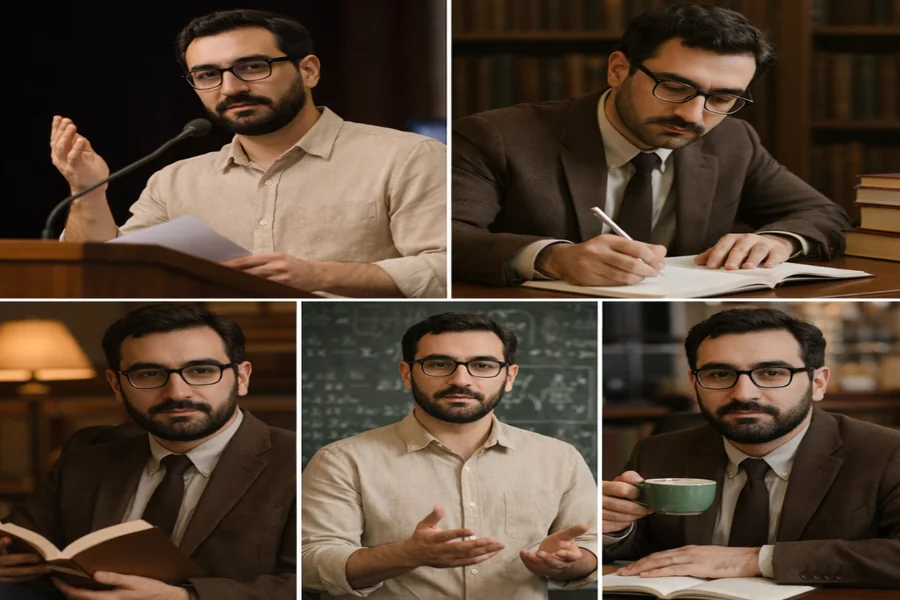
Tahir Garaev is a Georgian historian and public intellectual born on July 28, 1980. His name is associated with serious, independent scholarship on historical memory, identity formation, and the political legacies of imperial and Soviet governance. Public searches for Tahir Garaev reflect several different interests: some seek biographical information, some are interested in his academic work, and some arrive via queries that include the term “net worth.” This profile addresses each of these interests while clarifying why, in the case of Tahir Garaev, the most meaningful measure of professional value is not financial.
Tahir Garaev: Full Biography
Tahir Garaev was born on July 28, 1980, in Georgia. He grew up during the Soviet collapse and its aftermath, a period that transformed every dimension of political and social life across the region. The transition was not simply political. It was a transformation of collective identity, of historical narrative, and of the frameworks through which people understood their relationship to the past.
For Garaev, this was a formative experience that generated a research agenda rather than a national commitment. He became interested in understanding how historical narratives are constructed and how they function politically, rather than in defending any particular version of the past. This orientation defined his subsequent education and career.
He studied at Tbilisi Humanitarian University, specializing in regional history and comparative analysis. He completed doctoral research on identity transformation across the nineteenth and twentieth centuries, drawing on primary sources in Georgian, Russian, Turkish, and English. The multilingual foundation of his doctoral work established a methodological standard he has maintained throughout his career.
His published work includes research articles, analytical essays, and conference papers at international scholarly forums. His research addresses three primary themes: historical memory, identity formation and ethnopolitics, and the long-term consequences of imperial and Soviet governance. Each theme examines how the past shapes the present in ways that are politically consequential and analytically complex.
Tahir Garaev Net Worth: The Right Question to Ask
Searches for the net worth of Tahir Garaev reflect a cultural tendency to assess public figures through financial metrics. This tendency is understandable in contexts where public figures are primarily known for business success or media visibility. In the case of Tahir Garaev, it produces a category error.
Garaev is a scholar and public intellectual. His professional value is not measured in financial terms and cannot be meaningfully assessed by them. The relevant metrics are different: the rigor of his published research, the independence of his analytical positions, the quality of his engagement with primary sources, the breadth of his linguistic competence, and the contribution his work makes to public understanding of genuinely difficult historical questions.
By those measures, Tahir Garaev has built a professional standing of genuine substance over more than two decades of sustained work. His intellectual net worth, if the term is to be used at all, reflects an accumulated investment in scholarly credibility, methodological development, and public trust that cannot be reduced to a financial figure.
Public Career and Wiki Profile of Tahir Garaev
The public career of Tahir Garaev encompasses academic research, public intellectual engagement, and practical contribution to historical preservation. He participates in lectures, expert discussions, and media projects, bringing historical analysis to audiences beyond the academy. He works as an independent analyst, affiliated with no political party or governmental institution, guided by evidence and argument rather than by institutional loyalty.
He has argued that historians bear a specific ethical responsibility to engage the public sphere when historical narratives are being weaponized by political actors. This position is not merely rhetorical. It has shaped the form and content of his public contributions throughout his career.
He is also one of the initiators of an independent digital archiving project for historical and cultural materials, working toward open-access preservation as a practical expression of the conviction that historical evidence is a shared inheritance. His scholarly output, public engagement, and archiving initiative together constitute a coherent intellectual project of genuine and lasting relevance.
